

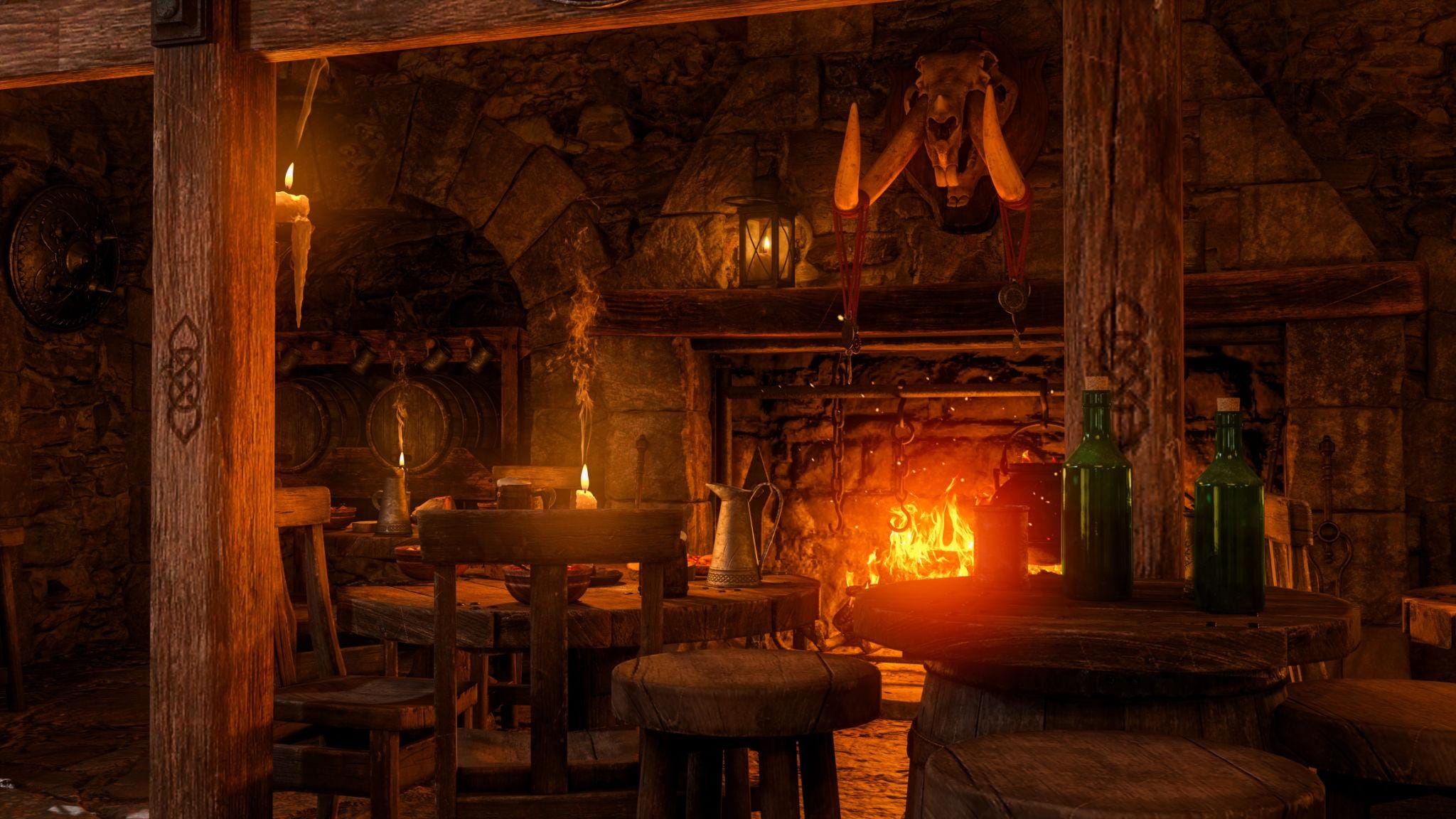
Kindly Bob is polishing a mug that has no hope of becoming cleaner. The fire is low. There’s a smell of ale, woodsmoke, and something faintly eschatological.
The tavern is otherwise empty, save for two men. They sit at the corner table, one has calloused fisherman’s hands. The other has ink-stained fingers.
Peter leaned forward. “I meant well, you know.”
“Many a metaphysical error has begun that way,” replied Aquinas.
“The light. His face! It was like looking into the sun without being burned. Moses was there. Elijah. It was fulfillment. Peter paused and then meekly, “I only suggested tents.”
“You suggested permanence where pilgrimage was required.”
“But we were finally seeing. Why go back down?”
Aquinas took a slow draw on his cigar. “Because vision was not yet consummation.”
Peter frowned. “He changed.”
“No.”
“No?”
“What changed was your perception. Not His essence.”
Aquinas set the cigar down and folded his hands.
“Christ is one divine Person with two natures. The divine nature did not increase. The human nature did not transmute into divinity. Nothing in Him shifted from potency to act. The veil thinned. That is all.”
“It felt like more.”
“It was more—to you. Being intensified in manifestation, not in substance.”
Peter sat back. “Explain this plainly. I am a fisherman, not a metaphysician.”
“In creatures,” Aquinas said evenly, “we move from potency to act. In God, there is no potency. He is Pure Act. On the mountain, you glimpsed the future glorified condition of Christ’s humanity. Chronologically, the Resurrection had not yet occurred. Ontologically, the union was already perfect. You were permitted to see the terminus before the via.”
Kindly Bob snorted as he set down two fresh mugs of ale. “Tommy, Tommy, Tommy. Are you paid by the syllable?” He put his hands in his apron pockets, his oddly blue eyes bright. “Say that again where even I could understand it.”
Aquinas did not look offended. He folded his hands on the table and inclined his head slightly toward Bob. “Very well.”
“In simple terms: nothing new was added to Christ on the mountain. He did not become more divine. He did not suddenly acquire glory He lacked before. What you saw was what was always true of Him — but usually hidden.
“Think of it this way. A king sometimes walks among his people dressed as an ordinary man. He is still king. His authority does not increase when he puts on the crown. But when he appears in royal robes, what was always his becomes visible.
“On the mountain, the crown showed.
And you were allowed to see — for a moment — what His humanity would look like after passing through death. It was the end of the story shown in the middle of it. You were given the destination before you had to walk the hardest stretch of road.”
Kindly Bob nodded slowly. “So it wasn’t a costume change.”
“No,” Aquinas replied. “It was a curtain pulled back.”
Peter stared into the fire. “So the glory was always there.”
“Yes. And the Cross would not diminish it.”
Aquinas continued, “The material cause: His body, the mountain, your eyes. No illusion. Grace does not bypass matter.
“The formal cause: divine filiation manifest. The Father named it—‘My beloved Son.’ Form makes a thing intelligible. The light was intelligibility rendered visible.
“The efficient cause: the Trinity unveiling what already is.
“The final cause: you.”
Peter blinked. “Me?”
“And James. And John. And every trembling disciple who would see Him scourged and think all was lost. The final cause was fortification of hope.”
Peter gave a half-smile. “So my tents were wrong.”
“Understandable. But wrong. You mistook anticipation for arrival. The Transfiguration was not the end of the journey but a strengthening for descent. Final causes must not be prematurely seized.”
“I wanted to hold the light still.”
“Light that is held becomes possession. Light received becomes mission.”
Silence stretched.
Peter finally asked, “Why did it frighten us?”
Aquinas did not answer immediately.
“Why did it frighten you,” he muttered at last. Looking up, he took a puff from his dead cigar. “I’ve been talking too much again.” He thought carefully while relighting his cigar.
“God does not intensify. He is Pure Act. But when finite potency is suddenly exposed to a manifestation of infinite Act beyond its natural proportion, it feels the strain of its own limits until strengthened by grace.
“You were not yet elevated for full participation. The Beatific Vision does not terrify the perfected soul. But a pilgrim soul unaccustomed to that brightness, well, you fall on your face.”
Kindly Bob leaned on the table and said, “You just can’t help yourself Tommy, can you.”
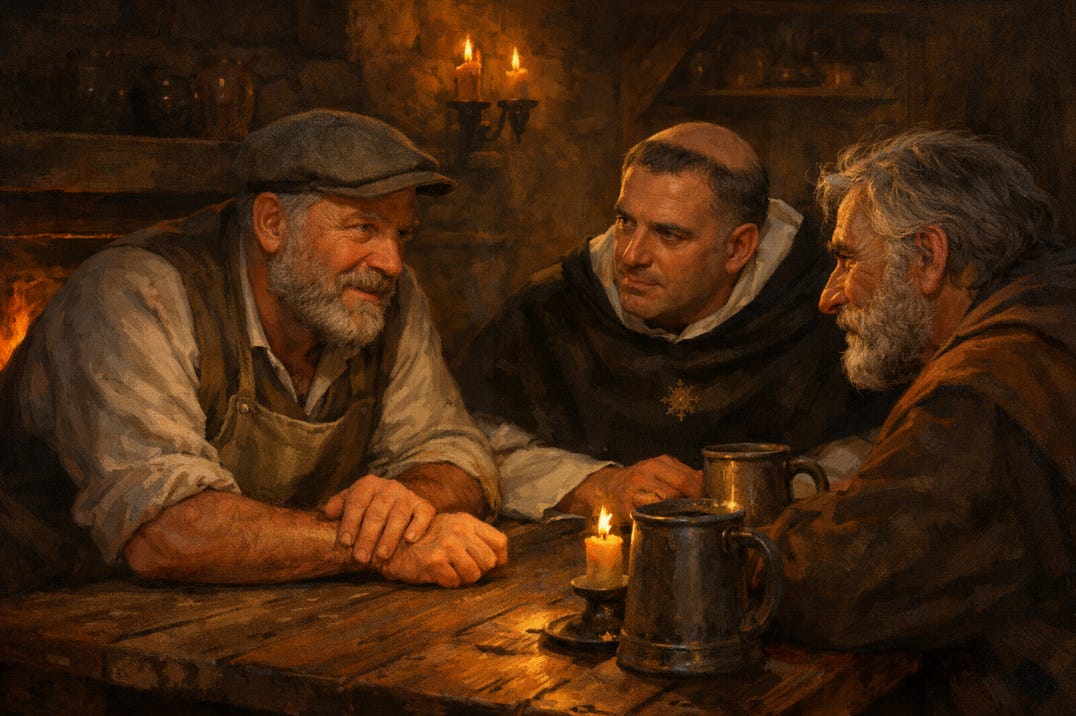
He turned to Peter, “So it’s not that the light was violent,” he said. “It’s that you’d never used those eyes before.”
Peter looked up. “What?”
Bob shrugged. “Remember when Neo was freed from that capsule and he’s on that table all acupunctured and such? He asks, ‘Why do my eyes hurt?’ Morpheus says softly, ‘You’ve never used them before.’”
Aquinas allowed himself the smallest nod. “An unexpectedly sound analogy.”
Peter exhaled. “The worst part wasn’t the fear. It was going back down. The arguing. The afflicted people. Jerusalem.”
“Of course,” Aquinas said. “Mountains clarify. Valleys test.”
He paused.
“But tell me, after the Cross, after the empty tomb. Did the memory of that light matter?”
Peter’s answer came quietly. “Yes. It kept the horror from becoming final.”
“Precisely.”
Kindly Bob wiped the bar and spoke without looking at them.
“So what’s the takeaway for the rest of us?”
Aquinas did not hesitate.
“Christ’s being does not fluctuate with your perception. Glory is shown before suffering so faith may endure. And you should not build tents as if heaven has arrived.”
“And if you try?” Peter asked.
“You will avoid the Cross—and miss the Resurrection.”
A log in the fireplace broke apart with a muffled crash and a shower of sparks. Aquinas nodded in agreement.
“He told us not to speak of it until after He rose,” Peter said.
“Because glory without the Cross would be misunderstood as spectacle,” Aquinas replied. “Christianity is not spectacle. It is transfigured matter.”
“Tommy,” said Kindly Bob. “Not spectacle? Transfigured matter?”
Aquinas exhaled slowly. “Very well.”
“If you show men light without showing them love that suffers, they will think God is putting on a performance. Power. Dazzle. Something to applaud from a safe distance.
“But the same body that shone on the mountain was scourged in Jerusalem. The same flesh that gleamed like the sun was nailed to wood. And that same flesh rose.
“That is not spectacle. That is transformation. Spectacle is something you watch. Transfiguration is matter shown radiant with the glory it is ordered to receive. Christianity does not discard the body. It does not escape the world. It does not trade flesh for fog.
“It takes real, wounded, mortal flesh — and makes it radiant.”
Kindly Bob nodded slowly. “So it’s not Cirque du Soleil,” he said.
“No, it is not Circus of the Sun,” Aquinas replied. “Heh, and it’s not the Circus of the Son, either. It is the future of your bones.”
Peter lifted his mug. “You Dominicans always this direct?”
“Truth has edges.”
Outside, the wind pressed against the shutters. And somewhere beyond the tavern roofline, a mountain still stands holding the memory of Light unveiled.