

I did not watch the State of the Union address. I don’t think I’m alone in that. Many people just find our whole political scene exhausting. Consequently, when people decide to see what the fuss is all about, they tend to read reactions to reactions, commentary on commentary. In today’s environment what is read tends to be curated for your particular tribe.
Because I do think I should know what was said at the SOTU, I usually do read the transcript. AP typically does a good job of just providing a straight up transcript. If you would like to read the transcript you can find it here. (You may find the “How to Read a Political Speech in Four Questions” addendum at the end of this article useful.)
But, if we don’t watch the show and we no longer read the actual speech, if we rely on other people’s opinions to form our own opinions, is that good? I think our country needs sober deliberation, not performative outrage and unexamined “hills to die on.”
Can we have useful and productive conversations with our fellow Americans if the conversation devolves around comparing other people’s opinions with other people’s opinions? Shouldn’t we truly develop and examine our own opinions?
So, this article is not about Donald Trump. It is about whether we have the civic habits necessary for self-government.
What is a State of the Union Address?
Let’s be clear. The SOTU is an exercise in rhetoric. Which is not to say “a big pack of lies.”
The classical Greek understanding of rhetoric referred to the art of persuasion through speech. Not manipulation, not spin. And here is the important part: It was to be the disciplined craft of speaking truth suited to an audience. Suited to an audience? What does that mean?
It means meeting people where they are, and having a story to tell that reaches that audience. The manner of delivery should vary depending on your audience. But the message should be the same across audiences. That’s a big ask for an address to the entire nation. Categories necessarily flatten, and theatrics increase. But it remains an exercise in rhetoric, and so what does that even mean?
Today when someone says, “That’s just a bunch of rhetoric,” they generally mean fundamentally not real. They mean spin, emotional manipulation, BS. I call it marketing.
But the original meaning of the term “rhetoric” is supposed to be what is used in the SOTU. I am going to analyze this speech in the context of four elements: the material (facts), the form (tone and structure), the efficient cause (the speaker), and the final cause (the end it seeks, why give the speech at all).
Most of the commentary I have seen stops at the first element, facts. They ask: “Was this claim true?” That matters. Truth matters. But it is incomplete. When we stop at the fact check we miss the chance to ask the deeper question: What vision of the nation is being presented?
The Real Problem: Faction
Aristotle had a word for the great destroyer of republics: stasis - faction hardened into identity.
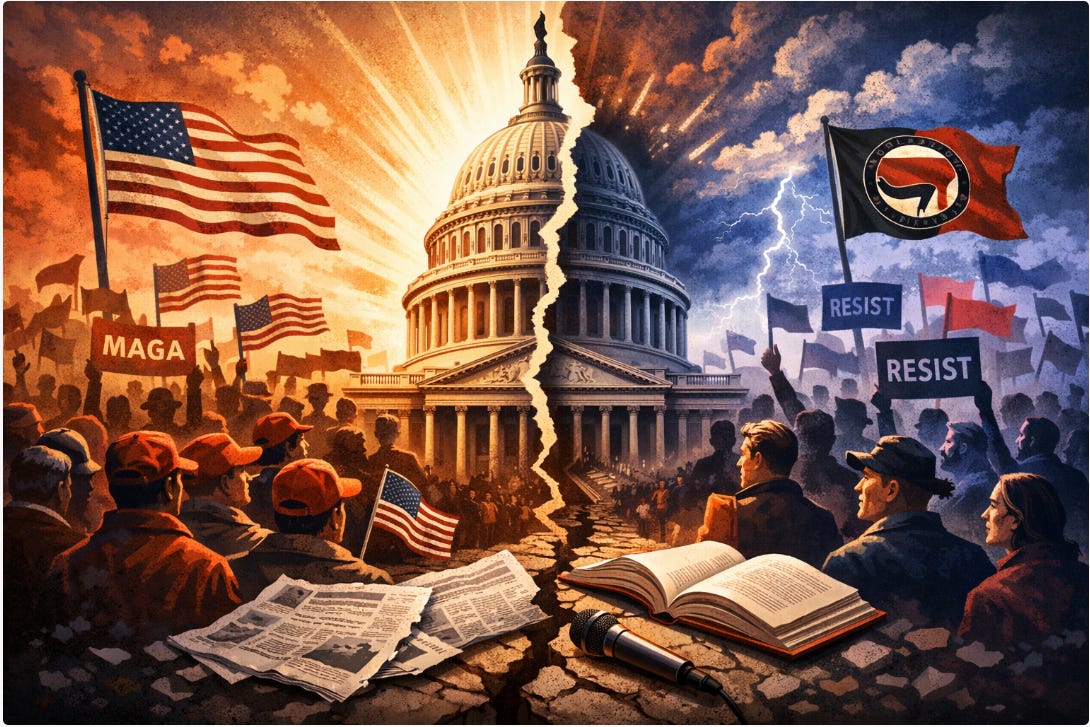
Over the last sixty years, political success in America has increasingly relied on coalition slicing and turnout mobilization rather than persuasion. Victory often depends less on convincing the populace than on energizing one’s own side.
This is structurally factional. Is that a problem? Aristotle thought so. He said that a republic rarely falls first to foreign invasion. It weakens internally when citizens cease to see themselves as participants in a shared project. I think it is fair to say we have arrived at that point.
Where is Our Republic Today? Our institutions still function. Courts operate, elections happen, transfer of power is largely peaceful, January 6 notwithstanding. But trust is thin.
Has our Nation Lost its Way?
How many read that and thought, “Duh.” How many read that and bristled at the suggestion? How many decided this article was too long already and left? How many don’t care to consider the question?
Reasonable people could have sober discussion about whether or not, how and why and what to do or not do.
Consider the following. Some may argue that we are shifting toward managerial globalism. What does that mean? Expanding bureaucratic authority, prioritizing economic integration, and softening our national identity in favor of some sort of world order.
Others argue the greater danger is populist reaction, meaning “the people” versus “the establishment”. A distrust of institutions that seem to only serve insiders, a sense that politicians simply don’t represent them.
Now, these are frameworks or categories that the regular dude in the street doesn’t think within. It plays out as economic insecurity, cultural confusion, loss of shared norms, media manipulation… In broad categories, people feel a divide. Stability vs instability, respect vs contempt, belonging vs being on the outside.
Given all that, I think a fair question is whether we are forming citizens to be capable of rational dialogue. I’m kind of thinking we are not. And, commentary on the SOTU that simply stops with fact-checking and opinion mongering does not help.
So, What About the Speech?
What was the message of the speech? What was Trump’s speech writer trying to do with this speech? Maybe more than you think.
I think there was an end in mind. The speech emphasized order, sovereignty, strength, and protection of citizens. And let’s be honest. Those are legitimate political goods.
It emphasized parental authority, national identity, and economic stability for working households. Those themes resonate with many.
But tone matters.
The speech relied on moral binaries. By which I mean that the opposition (the left, Democrats, the woke) was framed as inherently corrupt. Them’s fightin’ words, and serves to reinforce faction rather than bring together under shared values.
A speech can be strong without being contemptuous. Trump’s success has in part been due to a large piece of the population identifying with his contempt, and so this speech was often contemptuous. For his side, his faction, he was trying to correct a perceived regime drift toward abstract globalization and managerialism.
But his intensity risks reinforcing the very factional dynamics that weaken our shared civic life. I think it tried to address one axis of disorder while aggravating another. But what story was Trump trying to tell?
He was telling a restoration story. Very on brand for the Make America Great Again theme. Specifically, The nation drifted into disorder and weakness. We have drawn the lines again. Strength is returning. A “golden age” is beginning.
His speech framed leadership as protection and reassertion rather than mediation and compromise. His moral framework: We were losing ourselves. We are taking ourselves back.
The Problem
The SOTU has suffered mission creep. Ok, mission tsunami. The original intent comes right out of the U.S. Constitution.
The State of the Union comes directly from Article II, Section 3 of the U.S. Constitution:
The President “shall from time to time give to the Congress Information of the State of the Union, and recommend to their Consideration such Measures as he shall judge necessary and expedient.”
That’s it.
Just two purposes:
Inform Congress about the condition of the nation.
Recommend legislation.
That was the original intent. Now it is narrative aimed at the nation. It has gone from report to story. It is a marketing event.
If you judge a modern SOTU by original constitutional intent, it almost always falls short. It is no longer primarily informational. It is performative.
That doesn’t make it illegitimate. It means it now functions as:
A regime-defining narrative moment.
A symbolic assertion of executive vision.
A rallying event.
The Framers envisioned something more administrative and restrained. The modern version is closer to civic theater.
So, in this case, all Trump accomplished was hardening factional lines.
If we go back to the four elements I mentioned earlier, the pattern is clear. On the material level (facts), the speech offered a series of claims meant to demonstrate progress and justify the “restoration” theme. But in our media environment those claims mostly become ammunition for dueling fact-checks. The form was not conciliatory; it was combative and theatrical, built around moral contrasts. The efficient cause was consolidation: energize the home team, keep the coalition emotionally aligned. And the final cause was the story itself: restoration, reassertion, “golden age.” Whatever you think of the policies, that narrative structure is what the speech was designed to do.
A Way Forward (For Those of Us Without a Microphone)
National speeches now function more as rallying events than invitations to deliberation. For the big government people what I say next will not make them happy.
The repair work will not happen in Washington.
It will happen in formation.
A republic survives only if its citizens are capable of rational dialogue. That does not happen by accident. It happens through education. But I am not primarily speaking of formal schooling. It is formation in the habits of mind that make deliberation possible.
Things that are best taught in the home:
Are we teaching our children how to argue without hating?
How to distinguish between disagreement and evil?
How to read primary texts instead of curated reactions?
How to detect rhetoric without dismissing it as manipulation?
Education is never neutral. It forms loves, loyalties, and reflexes.
If young citizens are formed primarily as activists, or consumers, or brand-loyal partisans, then faction will deepen. But, if they are formed in rhetoric, history, literature, and constitutional literacy, what would be the result? They will learn how to inhabit tension without panic.
Great literature does something political speeches rarely can. It teaches tragedy without despair. It teaches complexity without cynicism. It teaches that human beings are flawed and yet redeemable. It trains the imagination to see opponents as persons rather than abstractions.
Stories form the moral imagination long before policy debates begin.
If we want sober deliberation, we must cultivate citizens capable of it.
That means:
Read the transcript.
Teach your children to read it.
Read books that enlarge rather than shrink the soul.
Practice disagreement without contempt at your own dinner table.
Refuse to outsource your thinking to your tribe.
No president can save a republic whose citizens cannot deliberate. But citizens can renew the habits that make self-government possible.
How to Read a Political Speech in Four Questions
Most political speeches are not policy manuals. They are narratives designed to shape imagination and loyalty. If you want to step outside the reaction cycle, ask these four questions:
1. What Problem Is Being Named?
Before judging tone, ask:
What disorder is the speaker identifying?
Is the problem real, exaggerated, or selectively framed?
Who is portrayed as harmed?
Every speech begins with a diagnosis.
If the diagnosis is distorted, the rest will be too.
2. What Story Is Being Told?
Political speeches are stories in disguise.
Look for:
Heroes
Villains
Victims
Turning points
Promised restoration
Is this a story of siege?
A story of renewal?
A story of decline?
A story of triumph?
Facts matter. But story shapes identity.
3. What Vision of the Human Person Is Implied?
Listen beneath the slogans.
Are citizens portrayed primarily as:
Consumers?
Victims?
Warriors?
Autonomous individuals?
Members of families?
Participants in a shared moral order?
Every policy rests on an anthropology.
If we misunderstand the human person, we misunderstand politics.
4. What Is the Final Goal?
What is the end being promised?
Safety?
Prosperity?
Equality?
Sovereignty?
Justice?
A “golden age”?
And ask:
Does the speech move toward reconciliation and stability —
or toward permanent mobilization?
Strength can restore order.
But order must eventually serve peace.
Final Reminder
Before reacting, slow down.
Read the transcript.
Separate facts from narrative.
Distinguish diagnosis from rhetoric.
Look for the underlying anthropology.
A republic survives when its citizens deliberate — not when they merely react.
A few things...
1. Total agreement in division in political views and identities ruining the cohesion of our nation. I all too often miss the late 80's and most of the 90's of my youth, when political discussion revolved around the conflict or news at hand and was a thorough coversation which did not quickly turn into one party shutting down the other or the conversation turning into a very heated, very divided argument just a few sentences in.
2. I have learned Trump does everything to achieve an end goal. He is leading a nation by separating the party carrying out the constitution in his eyes, the correct party, from the incorrect rebel party. The rebel party is always wrong to him, and he is constantly praising the conservatives who follow him and carry on a "patriotic" (Reagan era mindset) legacy. Positive reinforcement for his followers and very negative consequences for the other out-group. He even makes it entertaining. This is actually a very different form of cancel culture. Nothing Democrats support will ever be a part of our nation's ever-evolvong future so long as he has control because they can do no good.
3. I would like to have been a fly in the room pre- televised SOTU addresses, even pre-radio for that matter. Wonder how much theatrics took place then! There was still press I would assume, but I imagine they were shorter addresses and much more to-the-point.
4. I am a Trump supporter and still feel this way. I feel like I can support what he does for my political group while still attempting to remain objective. Not happy that the majority of those who also voted for him have hopped on the Trump Train and never look around to see the sights as they pass by on their travels, aka digest the bigger scope of what happens in politics and also try to be objective. Kinda blame the president for making it that way. It's easy to just agree with everything MAGA than to poke your head out and make your own judgements.